

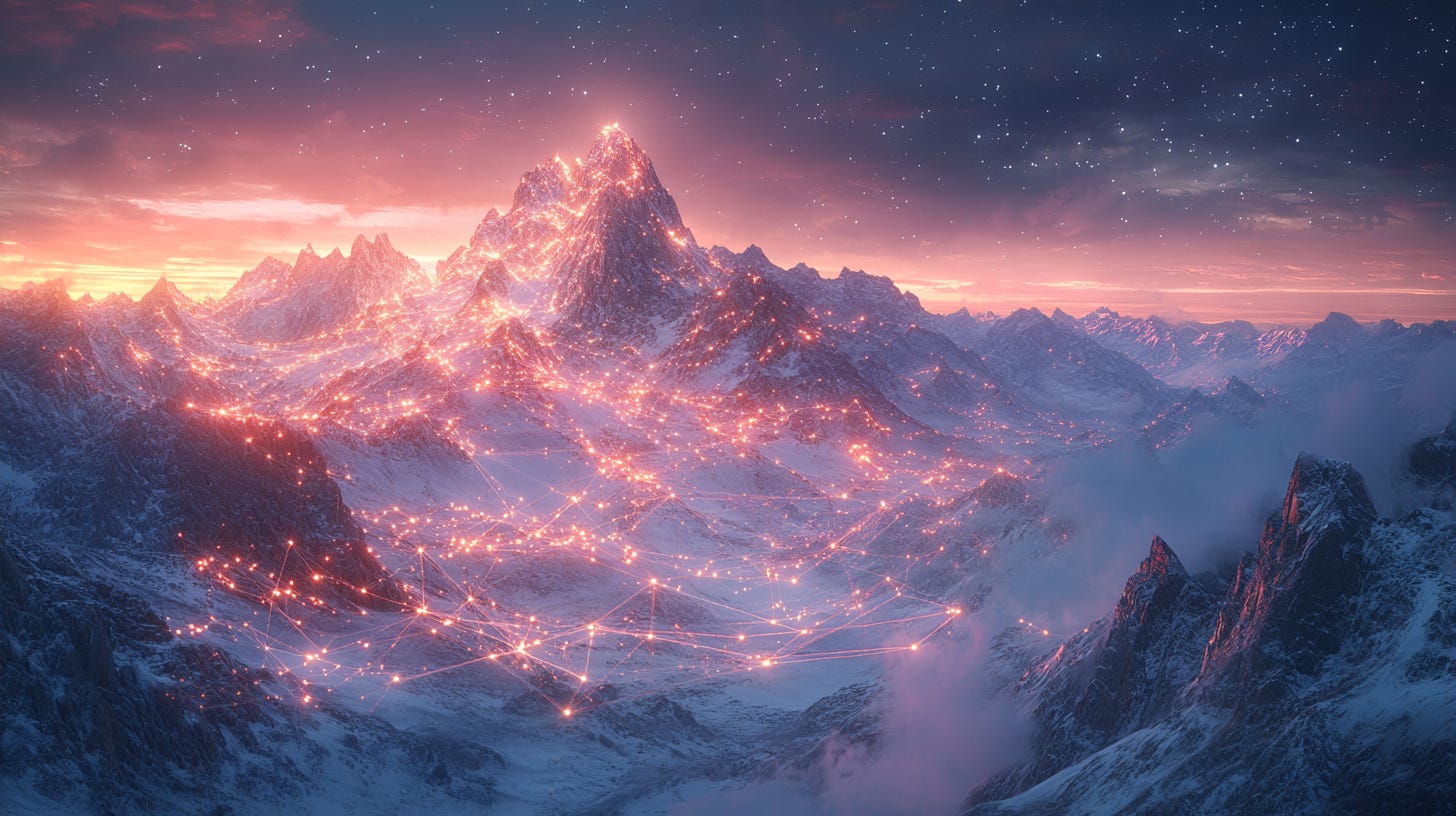
I was out walking with a friend last week, one of those aimless Sunday afternoon loops where you’re not really going anywhere and the conversation drifts between work and whatever’s on your mind, and she mentioned that the 2026 Winter Olympics aren’t really happening in one place but spread across four different mountain towns in Northern Italy. She works in telecoms infrastructure, has done for years, knows far more about this stuff than I do, and I could tell from the way she said it that she thought the logistics were properly mad. Cortina d’Ampezzo, Bormio, Livigno, Anterselva - not close to each other in any useful sense, separated by valleys and ridges and actual mountains, not a freeway between them. And Cellhire is deploying over 6,000 IoT and data connections across that terrain. I should say, I’ve recently started leading an IoT community, or maybe “leading” is too strong a word, I’m more like the person who organises the calls and tries not to say anything too stupid while people who actually know what they’re talking about have the conversation. But my friend’s description of the alpine connectivity problem stuck with me in a way I wasn’t expecting, and I haven’t been able to stop thinking about it since.
Mountains are not designed for the internet. I don’t mean that in some grand way, I just mean it practically. Almost everything in IoT, and I’m only now starting to properly understand this from listening to people in the community who’ve been doing it for years, assumes density. Smart cities, connected factories, autonomous vehicles, your nodes are close together, you run cables through basements, cellular towers serve hundreds of thousands of people, and the whole system is built around that. The Alps are not that. The Alps are not optimised for any of this. And yet somehow you’re supposed to broadcast real-time data from a snowstorm at 2,500 metres to a global audience, and it’s supposed to just work.
Six thousand connections across mountain terrain. I keep trying to picture what that actually looks like physically and I’m not sure I can. Cables on cliff faces. Radio masts at altitudes where the workers installing them need acclimatisation breaks. 5G networks in places where a storm could undo months of installation in an afternoon. My friend said that alpine IoT is “a different sport entirely” and I think she was being generous, because from what I can tell it’s less a sport and more a kind of organised stubbornness.
The thing I keep getting stuck on, and maybe this is obvious to everyone else, is that Cortina d’Ampezzo is a place where people have skied for a hundred years and the whole point has been to not wreck the landscape, and now you’re layering invisible digital infrastructure on top of it that has to be more reliable than the roads, because a skier crossing a finish line doesn’t care about your network topology, they care that the timing works, that the broadcast doesn’t cut, that their coaching staff gets the performance data before they’ve even taken their skis off.
Most of the IoT conversation, the conferences, the whitepapers, all of it, assumes you’re building somewhere that’s already set up for it. A factory has power. A city has infrastructure. A mountain just has rock and weather and a total indifference to whether your signal gets through. A few people in the community I run have tried to explain edge computing to me at various points and I think I’m only now properly getting it, which is basically that you can’t always send everything back to a central data centre when your nodes are this spread out, so instead you put smaller processing closer to where the data’s being generated and let each location handle things locally. In the Olympics context that means timing gates and sensors at each venue can capture and validate results on their own. If an avalanche takes out a cable, the local system keeps going. Which is, when you think about it, a pretty good design principle for anything that has to work when the world is watching.
The thing about distributed systems, and again I’m mostly parroting back what smarter people in the community have said, is that they don’t get a bit harder as you spread things out, they get a lot harder, because every new connection is somewhere else things can break and every kilometre is another variable you can’t fully control. The 2026 Olympics chose this on purpose. They wanted real mountains, real winter, the actual difficulty of it. And the cost of that choice is that the technology keeping it all together has to be better than anything you’d bother building in a city, and it has to be invisible, and nobody watching at home is ever supposed to think about it.
I don’t know what the takeaway is. I keep feeling like someone in my position is supposed to have a neat conclusion about distributed complexity or resilient architecture, but I don’t have one. What I’ve got is this nagging feeling that we’ve gotten so good at hiding the technology that we’ve lost track of how absurd it is. We’re building what amounts to invisible cities on top of mountains, temporary ones that last two weeks and then get taken down, and the whole thing has to work perfectly the first time because a couple of billion people are watching. I find that kind of amazing and kind of unsettling in roughly equal measure, and I haven’t figured out which feeling is the right one yet.