

I should say upfront that I am not an IoT person. I understand the general concept, connected devices, sensors talking to cloud systems, data flowing somewhere useful, and I find it genuinely interesting, but the moment anyone starts explaining protocols or radio frequencies my eyes glaze over in a way I try to disguise as thoughtfulness. I mention this because the thing I want to write about is technically quite involved, and I’m going to be interpreting it as a non-expert, which means I will almost certainly get some of the specifics wrong. What I don’t think I’m getting wrong is the idea underneath it. And it’s the idea that I can’t stop thinking about.
In February 2026, a group of researchers published a paper in Scientific Reports proposing what they called an AI-IoT smart agriculture pivot. The title alone tells you roughly nothing if you’re not already in the world. But the concept, once you understand what they actually built and more importantly what they chose not to build, is genuinely striking. Crop disease is one of the most stubborn problems in global food security. Plant pests and diseases destroy up to forty percent of major crops every year, costing the global economy something in the region of two hundred and twenty billion dollars annually. Rice loses up to thirty percent of yield. Wheat around twenty. These are not edge cases, they’re the expected outcome, year after year, and early detection is the thing everyone agrees could change the equation. Catch the disease early enough and you can treat it. Miss the early window and it spreads.
The conventional answer to this problem, the one that’s attracted most of the investment and attention and breathless conference keynotes, is drones. Autonomous aerial vehicles equipped with cameras and multispectral imaging, flying over fields, detecting disease signatures from the air. And drones are genuinely impressive. The technology is real, the results are real, companies are building commercial products around it and some farmers are using them to genuine effect. But drones also have a persistent set of problems that the technology has struggled to solve. They’re expensive, in ways that price out most of the farmers who need them most. They’re regulated, because autonomous flying things near farmland near airports near people requires a whole apparatus of approvals and certifications that vary by country and change frequently and require ongoing attention to maintain. They have limited battery life, which creates operational constraints on large farms. They struggle with certain terrain. And they require someone on the farm who understands how to use them, maintain them, interpret the data they produce, which in practice means either hiring someone or training someone, both of which cost something. The adoption data is pretty clear on this: the gap between the number of farmers who could theoretically benefit from drone technology and the number who actually use it is large, and it has remained large despite years of people confidently predicting it was about to close.
The researchers in the pivot paper looked at this situation and asked what I think is a genuinely useful question. Which is: what’s already in the field?
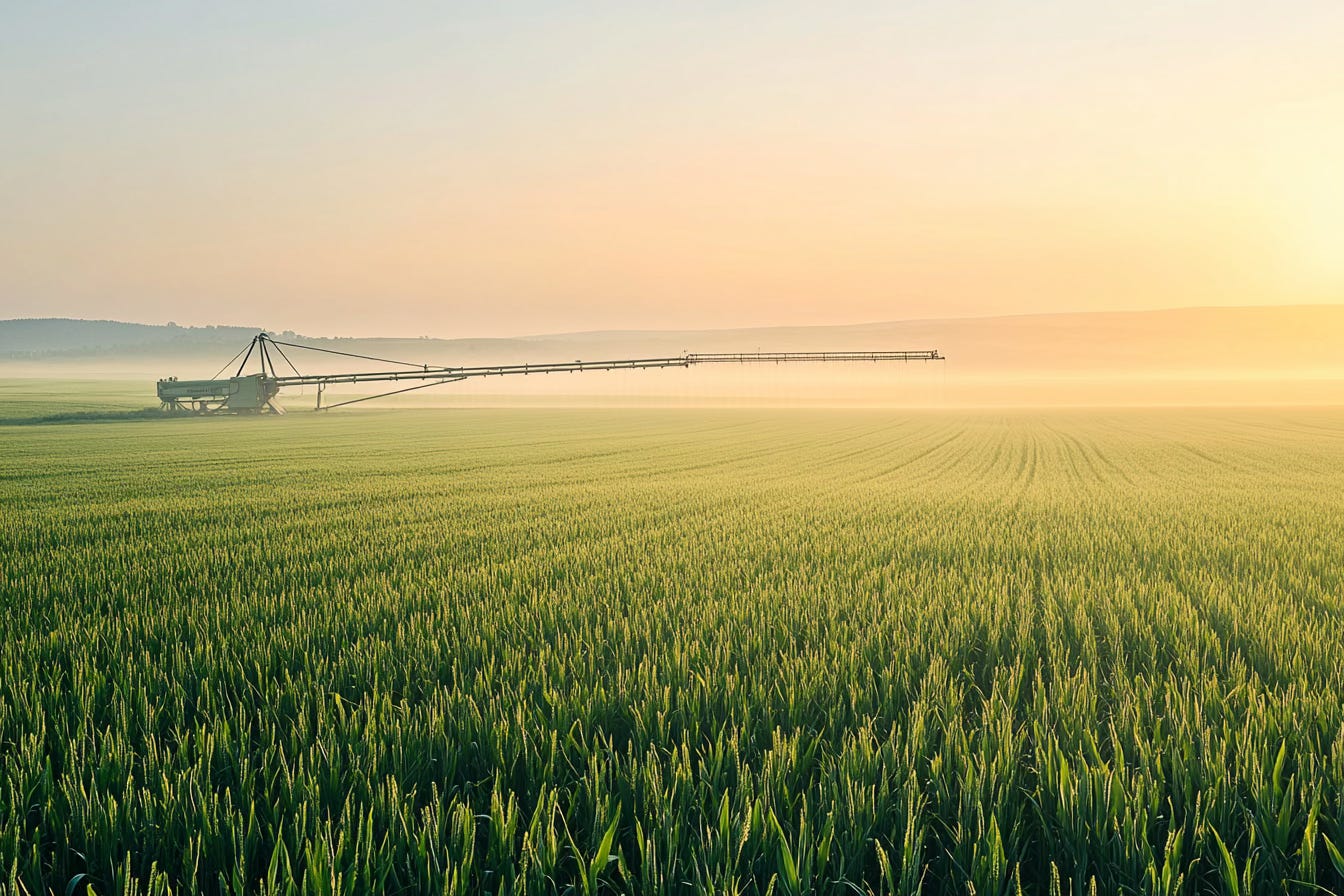
The answer, on a very large proportion of irrigated farmland globally, is a centre pivot irrigation system. If you’ve ever looked out of an aeroplane window over agricultural land and seen those enormous green circles, that’s what makes them. A centre pivot is a long arm, sometimes several hundred metres, mounted on wheeled towers, rotating slowly around a fixed central point, irrigating in a circle. It moves at roughly the speed of a very leisurely walk. It’s been doing this, in essentially the same form, since around the 1950s. It is, in the most literal sense, not exciting. It is also, on millions of hectares of farmland, already there.
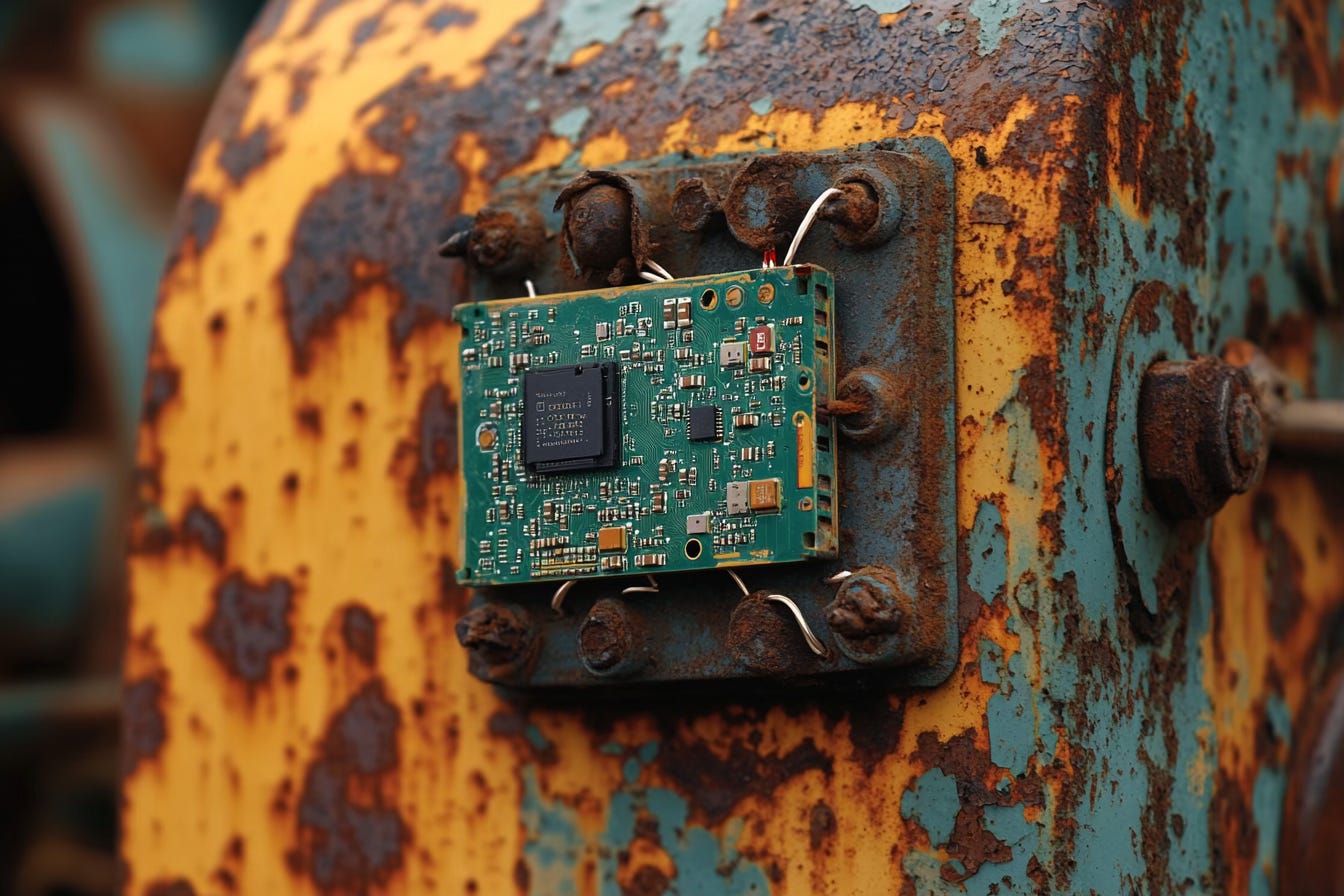
What the researchers proposed was mounting a Raspberry Pi, which is a small, cheap, single-board computer that you can buy for roughly thirty to forty pounds, onto the existing pivot infrastructure, connecting it to cameras and sensors, training a deep learning model to classify plant diseases from images of crop leaves, and letting the pivot carry the whole system over the field as it does its normal job. When the system detects disease, it doesn’t alert someone and wait. It triggers actuators to spray treatment at the point of detection, immediately, as part of the same pass. Detection and treatment in one movement, at low altitude, close to the crop, continuously, without any new infrastructure, without any new regulatory approvals, without any new operational complexity for the farmer. The disease classification accuracy they reported was 99.8 percent across eleven crop types, which I’ll be honest I found almost implausibly high until I read more about how these deep learning classifiers work on visual data, at which point it became merely very impressive.
I want to be careful not to oversell this. It’s a research paper, not a commercial product, and there’s a long road between a hardware pilot and something that ships to farms at scale. I genuinely don’t know what the engineering challenges look like when you move from a controlled test to the full variability of real agricultural conditions, and I suspect people who do know would have important things to say about why it’s harder than it looks. But the principle, the thing the paper is actually demonstrating, feels important in a way that extends beyond precision agriculture.

Because the question they asked, what’s already in the field, is one that I think most product teams, and honestly I include myself in this, tend not to ask early enough or seriously enough. The default instinct when you identify a problem is to think about what new thing you’d build to solve it. New hardware, new platform, new integration, new workflow. And sometimes that’s right. Sometimes the new thing is genuinely the right answer. But there’s a version of that instinct that’s less about finding the right solution and more about the cognitive satisfaction of starting fresh, of not being constrained by whatever already exists. I’ve been that person in enough product conversations to recognise the pattern. Someone describes a problem and I’m already thinking about the new thing before I’ve properly understood what the old thing does or doesn’t do. It’s a bias toward building over understanding, and I’ve rarely examined it as carefully as I should.
The smart pivot paper is interesting partly because the researchers clearly did examine it. They looked at drones and robotics, understood what both technologies could do, understood what they couldn’t do or couldn’t do reliably or couldn’t do cheaply, and then looked at what was already deployed at scale and asked whether the capability gap could be closed not by replacing the existing infrastructure but by making it smarter. The centre pivot doesn’t need to fly, because it’s already there. It doesn’t need to navigate terrain, because it moves in a circle on a fixed arm. It doesn’t need to worry about battery life, because it runs from mains power. It already covers the whole field as a byproduct of doing its normal job. The constraints that make it unglamorous are exactly what make it a better platform for this particular use case than a drone.
I keep coming back to a question I sat with for a long time in my own product work, and genuinely struggled to answer well. The question of what gets harder to replicate as you scale, what compounds, what becomes more defensible the more of it you have. And one of the honest answers I arrived at, eventually, was that embedding intelligence into infrastructure that’s already trusted and already deployed is a different kind of advantage than building something new. The trust is already there. The deployment is already done. The operational relationship with the customer is already established. What you’re doing is adding capability to something that already has permission to be where it is, doing what it does.

That’s not a new idea. But seeing it demonstrated so literally, in a research context where the researchers explicitly chose not to build the shiny thing and instead asked what the existing thing could become, made me think about how rarely I’ve seen that choice made with real discipline in product organisations. The pressure tends to run in the opposite direction. New things are fundable. New things are pitchable. New things get covered. Nobody writes a press release about the decision to not build the drone and instead put a Raspberry Pi on the irrigation arm. But that might be exactly the decision that produces the better outcome.
I don’t know enough about IoT, honestly, to know how widely applicable the specific architecture in this paper is. I don’t know whether centre pivots are uniquely suited to this kind of retrofit or whether the same thinking applies across agricultural machinery more broadly. I don’t know whether the connectivity and power assumptions that make the system work hold in the environments where the problem is worst. These feel like important questions and I am not the person to answer them. What I do think is that the question the paper asks, which is essentially not what should we build but what should we make smarter, is one that most product teams would benefit from sitting with longer than they usually do. Before the roadmap. Before the pitch. Before the architecture diagram. Just: what’s already in the field?
The primary source for the article is open access, to the full text for free:
https://www.nature.com/articles/s41598-025-98454-6
Published in Scientific Reports (Nature portfolio), 13 May 2025. Authors: Ibrahim, Mohsen et al. DOI: 10.1038/s41598-025-98454-6. It’s also on PubMed Central if you want a second link: https://pmc.ncbi.nlm.nih.gov/articles/PMC12075758/
Related papers worth linking
A companion piece published in Scientific Reports in July 2025 takes a similar approach but uses a portable edge device (Raspberry Pi 5 with a lightweight CNN called Tiny-LiteNet) rather than mounting on a pivot. Comes from the African Centre of Excellence in Internet of Things in Rwanda: https://www.nature.com/articles/s41598-025-06452-5
A third paper, published in Scientific Reports on 18 February 2026, combines smart irrigation with early plant disease detection using IoT sensors and neural networks. Most recent of the three: https://www.nature.com/articles/s41598-025-33323-w
The FAO crop loss statistic
The “up to 40% of crops lost” figure comes from the FAO directly: https://www.fao.org/plant-production-protection/about/en
The $220bn annual economic loss figure is from a widely-cited 2019 study in Nature Ecology & Evolution by Savary et al., referenced across multiple papers in the field.
All three Scientific Reports papers are open access under Creative Commons licences, so readers can read the full papers without a paywall.